trip to Argentina)
At Buenos Aires’s bustling Retiro Bus Terminal, we hopped aboard a spacious, first-class coach for the two-plus-hour ride northwest to San Antonio de Areco. San Antonio, a town of 25,000, is the oft-proclaimed capital of Argentina’s Pampas—the vast, fertile lowlands stretching across the country’s midsection from the Atlantic to the foothills of the Andes—
and cradle of the traditional culture of the Argentine cowpokes known
as gauchos.
From the desolate gas station that serves as the town’s bus depot, we walked more than a mile through nearly deserted streets to La Demorada, our very pleasant B&B for the next three nights. (Brother Dan had scoped out staying at one of the area's many estancias, or ranches, but we decided that, at $500usd or more per night, we'd rather find other ways to observe gaucho life.)


But for a very few exceptions the town's mostly one-story buildings, the landscaping and other amenities are all quite unadorned—one might say workaday. Of course, in the few blocks surrounding the town’s pretty central park, Plaza Ruiz de Arillano, there are a few more substantial buildings, including the ubiquitous Catholic church.

At first, we saw little to suggest that we’d arrived on the first day of the huge 80th-annual Fiesta Nacional de la Tradición, or Gaucho Fair. But as we began walking toward the town’s beautiful, riverside park, Parque de Criollo, we started seeing hints: horses, trailers and, sure enough, gauchos and their families arriving from all over Argentina.


 We also came across a small, sort of temporary-looking museum featuring a sampling of ceremonial gaucho paraphernalia: hand-tooled leather horse tack; ornate stirrups, spurs, knives / scabbards, belt buckles and sashes crafted of leather, wood, chased silver and re-purposed coins; and richly-woven saddle blankets.
We hung out for a while in the congenial, partly wooded park, watching as more and more people gathered—both fair participants and spectators. Runners worked out. Readers, picnickers and lovers lolled on the grass. Across the tranquil Areco River, in the pool just above a small dam, kids swam and dived and laughed.

And, of course, there were the horses. More of them by the minute, in every imaginable size and color. They seemed to be appearing out of nowhere. One little boy, in jaunty kid-gaucho attire—he couldn’t have been more than four—showed off his skills, effortlessly working his full-size horse around trees and through tight, high-speed figure eights. People seemed to barely notice him.


THE PLAIN, THE PLAIN!
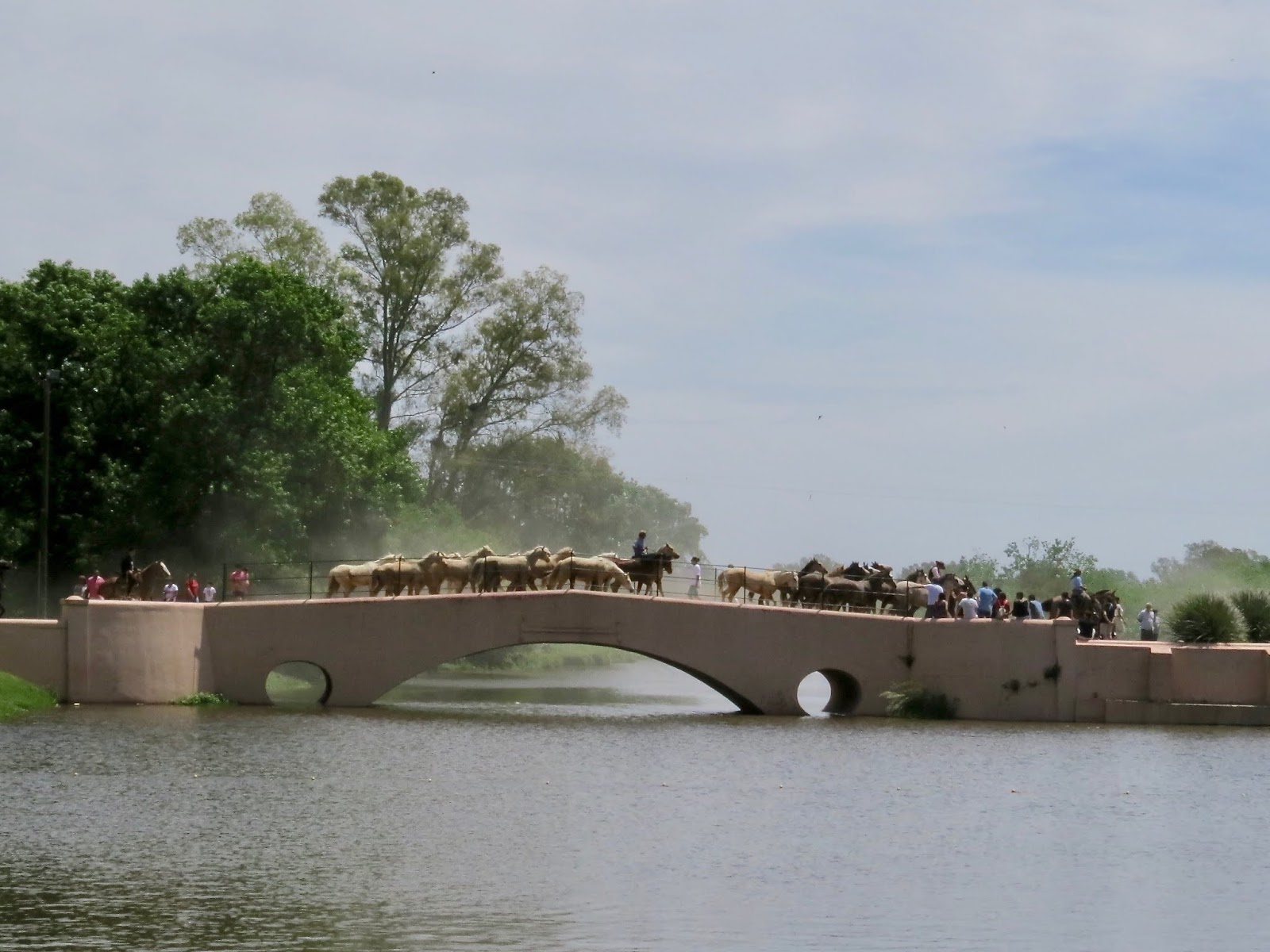
Eventually, there was movement. Across the Puente Viejo, or Old Bridge, they went, stirring up clouds of tawny dust. Everyone was headed for a large tract of flat, mostly treeless grassland about half a mile past the river.

We followed them into the fairgrounds, wishing now we’d worn our Wellingtons to slog through the many squishy, well-trampled mud holes left over from recent rains. Past booths selling craft items like leather work, tack and maté mugs made of wood or gourds. Past giant parrillas, or wood-fired grills, where whole pigs and sides of beef were roasting, and three-foot pots of guiso and other colorful, mouthwatering stews simmering. Ay-y-y, Dios mio, the smells!

Crowds slowly gathered along the fence surrounding one field, so Dan and I staked out a few square feet against the taut wires, bought a few empanadas and wine for lunch, and waited for the skills challenges to begin.
BUSTED BY BRONCOS
Gauchos are different from American cowboys in many ways, including their dress. (Most don baggy, accordion-pleated trousers called bombachas, gathered around the tops of their high boots, and loose, blousy shirts. Rakishly knotted scarves, colorful sashes—many of them adorned with silver—and jaunty berets complete the look.)
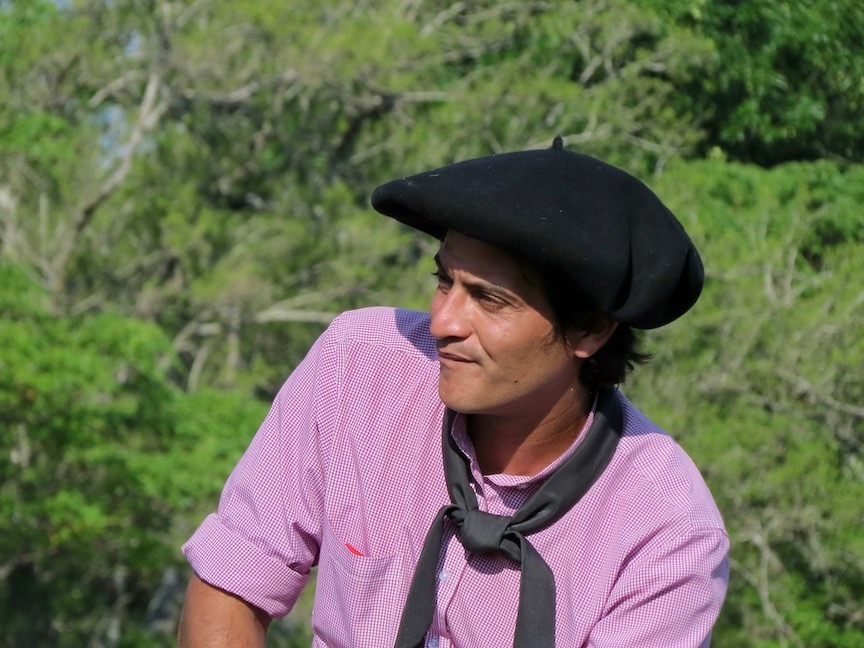


Their attitudes also differ. This fair highlights their pride in a lifestyle which shares many of the same values—independence, courage and loyalty for example—with American cowboys. But we’d heard that many gauchos feel bitter at having been marginalized for generations by the rest of Argentine culture. In fact, the word gaucho itself has been defined using the term mestizo, meaning anything from mixed-heritage to mongrel, depending on one’s point of view.)
One more or less familiar event at the fair was the jineteada gaucha, or bronc riding. Today it was a style called surera. As in North American rodeo’s bareback version of bronc riding, surera calls for the gaucho to use no saddle, sitting instead on just a thick sheepskin pad.
His only grip on the untamed horse involves squeezing it between his legs and holding onto a leather strap. And, instead of starting out from a fenced-in chute, these cowboys mount up while their horses are tethered to one of three wooden poles spaced out across one end of the field.


SAVED BY THE BELL
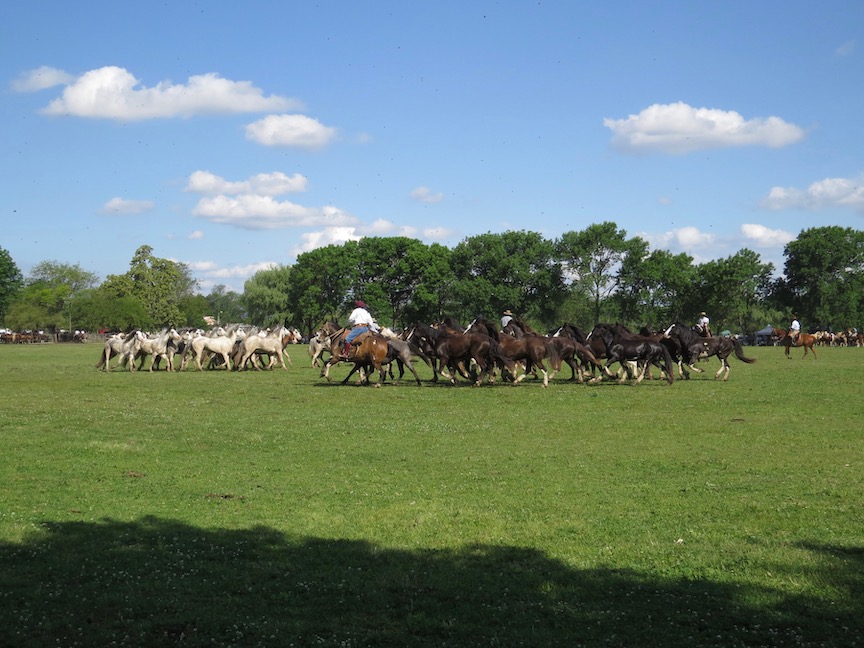
The other event that day, called tropilla, is nothing like any American rodeo event we’ve seen. In it, a rider guides his team of ten to twelve horses, most often all the same color, through a series of maneuvers—including intersecting with teams from competing estancias—hoping to keep them close together using only voice commands and the sound of a bell tied to the halter of another horse, usually of a different color.

 |
| PHOTO: Dan Willius |
That night we returned to the area near the fairgrounds where we expected to enjoy some barbecue, perhaps a little wine and, most importantly, the Peña Folklorica, a huge bonfire accompanied by spontaneous music, singing and dancing. Alas, despite several people’s very specific directions, the bonfire was nowhere to be found—unless, of course, it started after midnight.
So we settled for a very staged, very amplified concert of quite non-gauchesco pop music, some delicious sausage from a food truck and a couple of wonderful pastries from a table of young women raising money for, of all things, their hockey club. While Dan sought out photo-ops, I sat
at one of many long banks of picnic tables stretching across the lawn and struck up a conversation with a large, extended family who’d come from Buenos Aires for the weekend.


HORSE POWER!
 Next day we headed back into the town center and scouted out several possible vantage points for the day’s big parade. Judging from the crowds, it was quite obvious that the population of San Antonio had at least tripled during the fair. Not to mention the horse population, which must surely have quintupled.
There was an air of excitement along the curb as thousands of us waited for the first pasistas to round the corner. And then…there they were.

Mounted gauchos, decked out and dashing in all their gauchesco finery; women in long, colorful dresses draped—and, I’m sure, adhered somehow—over the horses’ rumps; kids, some in arms, others riding their own mounts; and a few elegant older men and women, some of whom we surmised were estancia owners.


How long would you expect a small-town parade to last? Half and hour? An hour maybe? Three hours later, we’re still standing there on the curb, and they’re still coming.


We decided to walk back toward the Parque Criollo and grab a late lunch. With empanadas and Cokes in hand, we took up another vantage point. Eventually, around 3:30, the last of the mounted pasistas passed, dispersing into the recessional now making its way back over the bridge toward the fairgrounds.
That evening, back at our B & B, I managed to polish off the bottle of Havana Club rum I’d opened a few days ago. (It’s really good mixed with orange juice!) And Dan worked on his bottle of so-so Argentine brandy. That helped take the edge off of our sadness at having to leave this lovely little town, this amazing experience, for the next legs of our trip—back to Buenos Aires by bus and then by air to Salta, the colonial, provincial capital in the northwestern corner of the country.