It’s my fourth trip to central Mexico with my compadre
, Silverio, the first being in 2003, shortly after I’d met him as my teacher in a beginner’s community ed Spanish class. Turns out he’d been planning a Spanish immersion experience for any of his students who were interested. I offered to help him promote the program, which we dubbed Voces del EspañoI
, created his first brochure, and have joined the group for that first trip and a couple of others since.
This time, in what I take as a great vote of confidence in my having absorbed the Spanish he’s infused in me these 15 years, Silverio’s asked me to help him with the teaching. (Fortunately for my two compañeras
, Olivia and Jane, they’re both at the advanced-beginner or early-intermediate level, so I feel I might actually have something to offer.) I also consider myself a student, as I still have a great deal to learn before I can pretend anything close to fluency.
Also joining us are Silverio’s three kids, Callahan, age 17; Madigan, 14 and Patrick, 11, who divide their time between attending morning classes with us and re-connecting with their Mexican grandma, aunts, uncles and cousins.
I always enjoy my time in this distinctly non-foreign-touristy part of the country—most of it spent in Querétaro state, where total immersion in the language is quite easy to come by. I especially love being with Silverio’s family, whose members have embraced me so generously over the years.
SAT., 7/28/18
It’s a smooth flight out of MSP, but the tight connection in DFW leaves no time for a even bathroom break, not to mention grabbing a bite of lunch. (Turns out all I get to eat all day is the trusty Snickers bar I always keep tucked away in a corner of my backpack.)

We’re met at the Mexico City airport by Silverio’s jovial brother-in-law, Manuel, and his son Daniel. They manage to pack ten of us and our luggage into two cars and we hit the road for the town of Tequisquiápan, Querétaro, where we’ll stay and have our classes all week. I enjoy chatting with Jane the whole way as we drive through the dreamy half-light and occasional rumble of sunset thunder storms.
Gradually, the density of the great megalopolis thins out, and we’re driving through the relatively flat countryside. Though Silverio promised we’d eat soon along the way, it’s not till we reach Tequis two-and-a-half hours later that we finally stop, at about 10:00 PM, at a small roadside taco shop.
There’s just a flimsy screen between
me and the comings and goings of a
Saturday night in a sketchy part of town.
My “welcome to Mexico” moment wastes no time elbowing its way into my life. Anxious to get some sleep, I find out Hotel Rio has no room for me, explaining that the previous guest trashed the room so badly that they couldn’t get it ready in time. After a long argument, they promise they’ll make it up to me with a nice hotel room elsewhere for the night and then their own plushest, king-bed room for the rest of the week.
So, led by some dude on a motorcycle, I’m taken across town to hotel La Querencia, where I find out exactly how serious they were about that offer. It’s a one-star hote…no,
hole. First of all, I look around and see—I’m thinking with good reason—no other guests. Bad sign. My room, on the 4th and hottest floor, has no A/C, no fan, no towels nor soap.
The mattress is as cheap and hard as a sheet of styrofoam, and the threadbare sheets bear signs of having been slept in a lot…and washed somewhat less. My only window opens right onto the public hallway, leaving just a flimsy screen between me and the comings and goings of a Saturday night in a sketchy part of town. Francisco, the proprietor, finally lugs up a big, noisy, industrial fan with two speeds: roaring 747 jet engine…and off. Hey, no worries; with the help of an Ambien, I’m soon oblivious to it all.
SUN., 7/29
It dawns a gorgeous day—not a cloud in the sky and lower 70’s. Shrouds of mist fall from the shoulders of the Sierra Madre Oriental along the horizon. Back at Hotel Rio, I have a small breakfast in anticipation of the big mid-day
barbacoa feed we’re invited to with Silverio’s large family. A little watered-down orange juice, a bit of granola and yogurt, a few chunks of fresh papaya and a to-go cup of surprisingly good coffee should tide me over. Jane and Olivia decide to stay in Tequis to explore and possibly go to church.
About 10:30 we hit the road for Ezekiel Montes, Cadereyta & our destination, Bóye, home of Don Chon’s famous barbacoa* hall. Señor Chon died some years ago, but the whole extended family still runs the place. Though I’m far from knowledgeable about barbacoa, I’ve never tasted any better!
Among the choices are
borrega (sheep);
chivo (goat);
montalayo (lamb stomach); and
pulque - fermented maguey juice, sugar and some seeds I don’t recognize. As an indication of how big this dish is for this little town, I’m told that during the town’s big barbacoa festival in September they go through 900 to 1000 sheep!!

After lunch, Manuel pulls a bottle of tequila out of his cooler and we (men-only), joined by the two proprietors, Don Chon’s sons, set to polishing it off, mixed with grapefruit soda to make
palomas (doves).
Fully stuffed, we head back to Neli’s house in Ezekiel where we men pick up the tequila drinking where we’d left off, aiming to put away another two bottles—in the middle of the day yet. This time we take it straight, with limes as fresh as they get, picked from the tree right outside the door.
With my Spanish well primed by the tequila, I enjoy a great, long talk with Silverio’s brother Alberto, who seems not to favor me with his pace or vocabulary. Ranging from politics to faith to sports to language, the conversation really helps tune my ear, speed up my rhythm and bolster my confidence.
Eventually, we all move outdoors to the patio where we play
brisca—a fascinating and tricky card game—for 20 pesos (about one U.S. dollar) a game. Teamed with Manuel—and helped considerably by Silverio’s sister Lety—we end up winning most of five or six hands. To the delight of all, one of our opponents, the hyper-competitive Silverio, is beside himself.
While the Rioses prepare another huge barbacoa of their own at Neli’s, I get a ride back to Tequis from designated driver Daniel and join Olivia and Jane for dinner at the hotel. It feels really good to finally have a comfortable room—though neither the Internet nor cellular service works. Oh well, it is Mexico…and besides, I’m too tired for technology anyway.
MON., 7/30
After a modest buffet breakfast at the hotel, our first class starts at 9:00 in the large, well-appointed conference room. It’s great having Silverio’s kids be part of the group—Callahan and Madigan actually learning Spanish, and Patrick documenting the class as official
Voces del Español photographer.
 |
| PHOTO: Patrick Rios |
Among our well-planned class activities, we each introduce ourselves and share some basics about our lives; discuss some background on Latin American countries, Mexico, Querétaro state and Tequisquiápan; play games; and listen to a song, filling in spaces for missing and erroneous words sprinkled among the printed lyrics.
During lunch break, I walk the few blocks to the
zócalo (town square) for lunch and to buy some sun block and water.
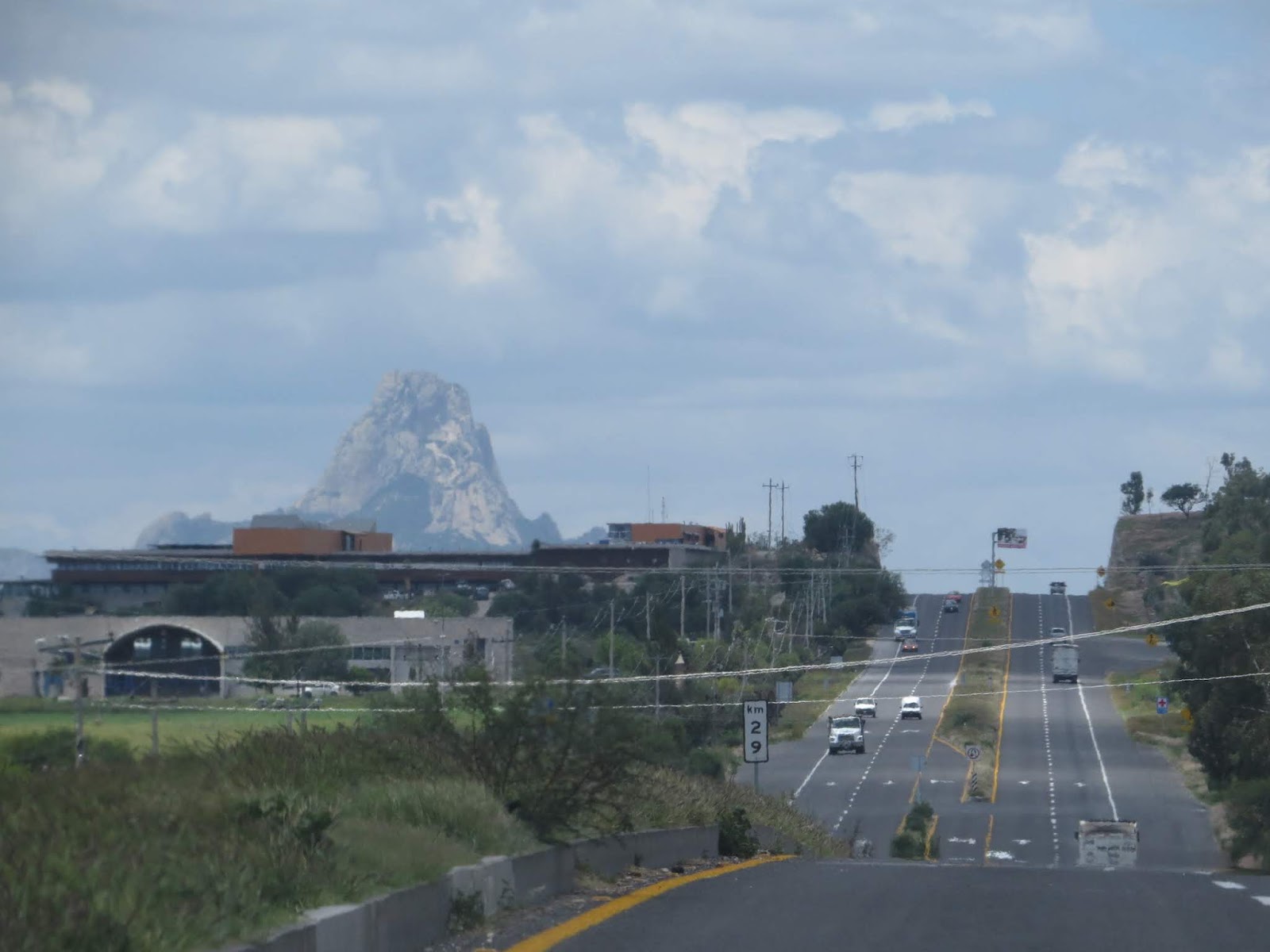
Today’s afternoon excursion is to Bernal, some 35 miles west of Ezekiel Montes, home of La Peña, a Jurassic-period rock formation billed as the world’s third-largest stone monolith. (It's actually number ten.) We each climb the flank of the
monolito as far as our respective abilities and desires allow. Silverio and I get as far as about half-way up the part climbable without technical equipment. Then I head back down while he continues up to meet his kids, who’ve climbed to the very top.
On the pleasant ride home I introduce the group—minus Callahan and Madigan, who’ve opted to nap in the back of the SUV—to my favorite car game, Think Pink, for which Patrick shows a quick aptitude. Macho muchacho.
We arrive back at the hotel at about 7:30. I ask Olivia and Jane to join me for dinner at K-puchino’s, a favorite restaurant just off the zócalo I’ve been to several times on previous trips. I get to be a minor hero for the restaurant’s having menu selections meeting my compañeras’ special dietary needs.
After dinner, Jane treats us to a nice gelato, which we enjoy at an outdoor table on a quiet side street.
The thought crosses my mind of
renouncing what may soon have
become a visionless, cowardly,
neocon United States for a new,
kinder, saner life here.
TUES., 7/31
Morning classes go well, accompanied by coffee and cookies. For lunch, I walk to the zócalo—locals also call it
El Jardin (garden). Since I’ve been dearly missing my accustomed 5- or 6-o’clock cocktail due to our “Mexican-time” meal schedule, I buy myself a four-dollar bottle of tequila and a couple of Squirts to make palomas for myself before dinner.

Our afternoon outing today takes us to nearby (7-8 km) La Trinidad, where we hook up with Saul Hernandez—“El Peñon” (the crag)—our guide for the afternoon’s tour of the area’s opal mines. He’s a fourth-generation miner, who spends four days a week digging and breaking rocks, and the other three leading tours.
Like ice cubes in a blender, we’re jolted up the steep
cerro (large hill or small mountain) in the back of his pickup. Once at the small mine pit, we we’re each handed a miner’s hammer and a stone chisel, and turned loose on piles of slag and on the face of the cliff.
Hopes run high, as Saul promises us we can keep any opals we uncover. Surprisingly, they’re quite easy to find, though of very low commercial quality. Silverio’s kids are engrossed for nearly an hour (and then even happier later when their dad buys each of them an opal ring from the Hernandez family’s small shop).
On the way back down the cerro, we pick up a friendly, 30-something woman and her small son, who, at age 3-4, already sports his own
martillo de minero (miner’s hammer).
Somehow, between body blows from the sides of the truck bed and spotting dogs, cattle and wild quail, we get back on the Think Pink train for a few minutes, just long enough to come up with my compañeros’ favorite rhyme of the trip so far, this one in Spanish:
caca de vaca (cow poop).
No wonder, on the drive back to the hotel—in fact, for most of the afternoon—I’m craving beef. So, on our arrival I make a beeline for the zócalo, where I find exactly what I’m looking for:
arrachera, a delicious—sometimes tender—rendition of flank steak. It’s a wonderful meal, accompanied by steamed veggies, rice and beans, and garnished with the sights and sounds of families and couples enjoying their lovely, utterly charming little town.
As I sit here, with no one to talk to except my waiter, the thought crosses my mind of renouncing what may soon have become a visionless, cowardly, neocon United States for a new, kinder, saner life here in Tequisquiápan.
On my way back to my room, I run into Jane and Olivia in the hotel bar, where I join them for another drink and a nice conversation before turning in. After having not slept well for four nights in a row, I’m hoping the glow of this wonderful day will be the only sleep aid I’ll need.
WED., 8/1
At last a good night’s sleep! With our hotel managing to renege on several aspects of their contract with Silverio, we’re left without access to the conference room today. So we amble into town, where we end up having our class at a very nice table in the inner patio of the Plaza Hotel.
(By the way, I’ve not been quite sure how much of a challenge this trip would be for my wanna-be Spanish fluency. But it’s turning out to be everything I might have hoped for, with ample opportunities every day not just to learn some grammatical things I’d never known or had gotten rusty at, but also to practice with non-English speakers. (Nice to know an old dog can still learn a few new trucos.))
Around 3:30 we hop into Silverio’s nephew’s SUV and head for the Cava de Boca Negra cheese factory tour. Little do we realize this will be just the start of an afternoon of nearly continuous—and probably, in hindsight, comical—mishaps. The worst is the fact that instead of steering us on the simple, 15-to-20-minute route to our destination, Siri, or whatever her goddamn name is, decides to take us on an hour-and-a-half side trip all the way to Ciudad Querétaro.
Even when we realize HER error, we find ourselves in a revolving-door of u-turns on a very visitor-unfriendly stretch of highway. Finally, Callahan, bless her heart, succeeds in navigating us—nearly all the way back to where we’d started—to the cheese tour, where, unfortunately, Silverio’s mom, sister Neli, a niece and a nephew have been waiting for us since 2:00.
The cheese tour proves interesting and informative, including a nice wine-and-cheese tasting outside on the patio. But we’re disappointed to find that the place’s restaurant, where we’d been hoping to have dinner, has just closed at 5:30. So we head to a local-favorite seafood place recommended by Neli, where at least a couple of us enjoy the authentic, distinctly non-touristy vibe more than the food.
 (I’m feeling so sorry for my dear compadre, Silverio, who’s invested so much in this trip and who’d so hoped to provide another smooth-running day for us. He’s an incredibly patient man, but the stress is showing. We all assure him the day’s been far from a total loss, and that tomorrow will surely smile on us.)
Arriving home relatively early leaves me much of the evening to stroll to El Jardin for an ice cream and to listen to—and then visit with—a very accomplished strolling musician.
When Fernando opens the door and
sweeps us into the spacious gallery
area, there are audible gasps from
my compañeras.
THUR., 8/2
It’s already dawning on me how soon this wonderful week will be ending. Today, since we’re again making the long drive to Querétaro, we decide to take off right away and find a nice outdoor space there for our morning class.
After yet another ridiculous series of arguments with Siri about the navigation, we finally arrive in the historic center of Ciudad Querétaro thanks only to Silverio’s good—and distinctly non-digital—sense of direction. We amble a few blocks from La Plaza de Armas and find a pleasant restaurant in which to hold the day’s brief class.

After a very good lunch, we head to the home of Fernando Garrido in the northern suburb of Juriquilla, this time arriving with no bum steers from GPS. Fernando’s the incredible magical-realist painter we connected with on our first Voces trip back in 2003, and who’s become my good friend.
What a joy it is to be welcomed, with such open arms and heart, by this remarkable man! Soon Fernando’s wife Jacqueline—an amazing painter herself—joins us, and after introductions all around we settle in in their wonderful back-yard patio for a glass of wine and to catch up on our respective lives.
We’d hoped to see their son, Alexis, who was eight when we first met. But, now 23, he’s spending his last semester of civil engineering studies in Bremen, Germany. His parents are very proud.
Eventually, we head to the couple’s new gallery/studio, a modern, crisply-designed building just a few blocks from their home. When Fernando opens the door and sweeps us into the spacious gallery area, there are audible gasps from my compañeras. There, spread out before us on the pristine white walls, are at least a dozen of Fernando’s mind-blowing works, along with several of Jacqueline’s. (He apologizes for the fact that what we're ooh-ing and ahh-ing about are really just reproductions, since having the real thing there would make their insurance unaffordable.)
On the second level are a comfortable, black-and-white lounge area and bright his-and-her studio spaces—with Fernando’s current work-in-progress already pulsing with life on its easel.
In addition to working and sitting areas, the space spills out onto a wonderful outdoor deck overlooking the surrounding jungle-like back yard, and another lovely seating area—all interconnected by elegant catwalks.
With promises of a next visit—in either Minneapolis, Zihuatanejo, Mexico City (to see Fernando’s upcoming exhibition) or back here in Querétaro—we say our goodbyes and head back to Tequis, but not without another spate of insults to our intelligence by Siri.
Despite our long-unmet needs for food, water and rest, we manage to stay more or less on track and arrive, exhausted, back at our hotel at about 6:30.
I stop at the local fresh fruit market for some of those amazing little fingerling bananas. I’ve been craving bananas all week since, surprisingly, our hotel’s restaurant doesn’t offer them. I also pick out a fine-looking mango, with which I’m eagerly looking forward to supplementing tomorrow’s breakfast.
Olivia and Jane join me for dinner just off the zócalo at a charming little back-street pizza place I discovered. We enjoy a nice meal, a couple of artisanal beers and some good conversation. Afterwards, Olivia takes her turn treating us to ice cream and, happily savoring it, we head back to the Hotel Rios.
I realize, sadly, that tomorrow’s our last day. We’ll head for Mexico City in the afternoon, where I’m thinking we’ll spend the night with one of Silverio’s sisters before our early AM Saturday flight back home.
Expecting anyone
or anything to
salve a gringo’s sense of righteous
indignation simply
does not work here.
FRI., 8/3
I savor what’s to be the last of my favorite waiter, Arturo’s, powerful, puts-hair-on-your-chest cafe lattes. (I swear the guy must put five shots in each one; I can nurse one to last all morning.) Again we must work out some financial issues—this time not just between the hotel and Silverio, but between him and my two compañeras—which threatens to put a damper on the week’s many joys for me.
I’m torn between wanting to understand Jane and Olivia’s feeling they’ve been treated unfairly, and my friendship and deep respect for Silverio. I know he's been jerked around by the hotel and is already incurring extra costs beyond his control—which the ladies insist he simply absorb.
I try to explain that my compadre doesn't organize these trips because he expects to make money as a travel agent; he's a teacher simply trying to provide a rich, rewarding learning experience for his students.
Another factor, one I decide not to bring up, is my understanding, from much experience traveling throughout Latin America, that when things fall short of one’s expectations—even matters on which you’re sure you have the high moral and/or legal ground—expecting anyone or anything to salve a gringo’s sense of righteous indignation simply does not work here.
Putting those issues at least temporarily behind us—and Silverio admirably maintaining his professional demeanor—we check out of the hotel, pack up the car and head downtown once again to see if we can fulfill Olivia’s hopes of buying a pair of handcrafted
huaraches—those sandals with the fine, woven leather vamps.
Finding nothing but machine-made sandals in Tequisquiápan’s several crafts markets, we drive down to San Juan del Rio to see if we’ll have any better luck there. Voila! She finds exactly what she wants at the main artisans’ market—even buys a second pair as a gift. (I'm hoping this has earned back a few points in Olivia's estimation of Silverio.)
We stay and have a nice lunch at a second-floor
lonchería in San Juan, and then head back up to Ezekiel Montes to pick up Silverio’s suitcase and his young nephew for the long drive down to Mexico City. (At Olivia’s refusal, the offer from one of Silverio's sisters to lodge us tonight in her home goes by the wayside. So now, because of our early morning flight tomorrow, the goal is to get us a hotel near the airport so we can get up at 5:30 AM instead of the 3:00 wake-up we’d face if we stayed the night in Tequis.)
The two-and-a-half-hour drive we expected to the edge of the sprawling city expands by another hour once we hit the city’s Friday-afternoon rush-hour traffic. Between the frantic driving and the horrible condition of the freeways and streets, I’m sure glad I’m not the one the driving.
Silverio, doing his usual amazing job of driving, drops us off at the Fiesta Inn at about 6:30. I grab a quick margarita in the bar and then enjoy a pretty decent buffet dinner in the hotel restaurant before getting my gear in order and hitting the hay.
(Silverio invited me to join the Mexico City part of his family for the evening, but I decide it’s best to start dialing in my focus on getting home. I absolutely love Tequisquiápan, Querétaro and, of course, my Mexican “family,” but I so miss Sally and our sweet little girl, Sylvia.)
Warmed through and through as I am by yet another round of memories from this special place and these dear people who live here, it will be good to get home.
*
Mexican barbacoa is perhaps the most well-known, and its most popular manifestation is that which is used in the central states of the country. A brick-lined oven, usually about 60 centimeters (23 inches) in diameter and about a meter (3 feet) deep, is dug into the earth. Wood is placed at the bottom and burned until the whole oven is red hot.
A large pot is prepared with a little liquid (usually water and/or pulque with vegetables and aromatic herbs) and a grille in the bottom so that the meat does not touch the bottom of the pot. Meat, usually lamb or mutton, is wrapped in maguey leaves and placed inside the pot, then topped with the animal’s stomach, into which has been stuffed the other edible organs and a mixture of herbs, spices, and chiles.
The oven is covered with a metal sheet and a layer of fresh earth, then left overnight for the meat to cook undisturbed. When uncovered, the organs (often called pancita de barbacoa) and the leaf-wrapped meat are perfectly cooked to tender, moist goodness, and the liquid has turned into a delicious soup. Frequent partakers of this rustic culinary masterpiece often do justice to all three parts, starting their meal off with a small bowl of the brothy soup (called consomé), followed by tacos made from the internal organs and finally tacos made from the meat itself wrapped into soft corn tortillas.
THE SPRUCE EATS