Showing posts with label art. Show all posts

Friday, November 25, 2022

Oaxaca En Mente / Oaxaca On My Mind - Part 5

PART 5 OF 5 PARTS

ART AND HANDICRAFTS

Not everyone agrees on which art form best exemplifies Oaxaca. But for me it’s alebrijes, those fantastical, intricately painted wooden figures often combining features of different critters. Some say they represent spirit guides.

Pedro Linares

As much as I’d love to think the art form originated in Oaxaca with the pre-hispanic Zapotec or Mixtec cultures, the idea actually dates from the early 1940s and a Mexico City cartonero, or garbage collector, named Pedro Linares. The story goes that Linares, while in a fever-induced coma, dreamed he was in a magical forest, visited by surreal mash-ups of various animals. Some of them uttered a strange declaration: ¡Alebrije!

When he recovered he decided to give form to those visions, crafting the figures out of paper scraps and wheat glue.  

Then Linares’s work was discovered and afforded some exposure by Diego Rivera and Frida Kahlo. But it was only decades later, in the 1980s, that Oaxacan artisans, already carving various figures out of Copal wood, saw Linares’s work at an exhibition and began adopting its whimsical interpretations and vivid coloration—and the name alebrijes. *

I’m determined to take home a nice alebrije as a souvenir of Oaxaca. So I’m especially aware as I pass the many shops and street stalls selling them. There’s obviously a wide range of quality—and prices. So when the opportunity to learn more about the art form presents itself I jump on it.

That Friday, skipping my usual morning Spanish class, I head to a village, about 20 miles southwest of the city, called Arrazola, one of the two places in Mexico best known for the quality of its alebrijes.

      He induces chemical reactions...
      to make one color dramatically
      turn to another.


A young man in one of the talleres, or workshops, leads me through a stunning gallery of the finished product and into the family’s sunny, wood-scented studio. There he shows me the whole production process, from selecting, curing and priming the protium copal wood, to dreaming up the designs, to making the super-bright paints. 
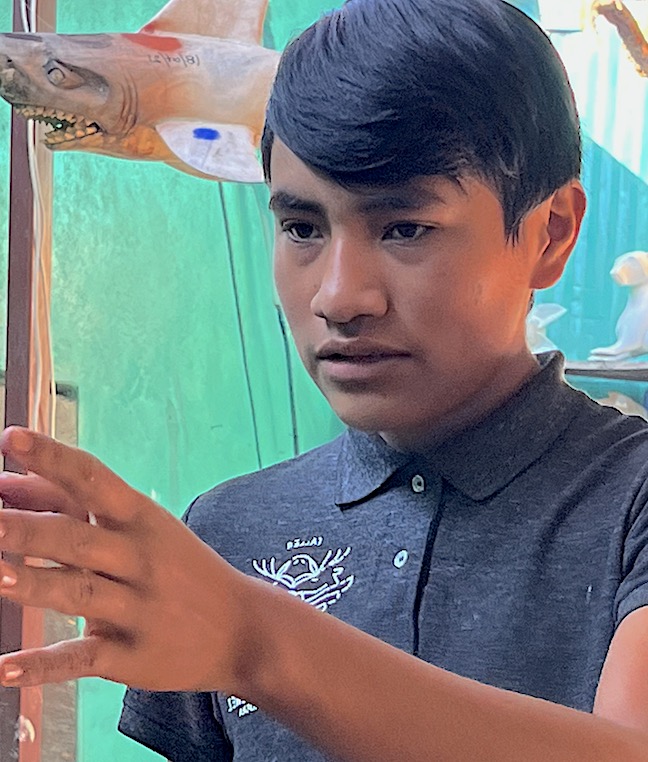
He demonstrates how they make the colors by combining minerals with various raw materials, like oils or pulverized cochineal—a tiny, brownish scale insect widely used in red dyes, including those found in foods and beverages. He also induces chemical reactions, using readily available substances like lime juice, or even mezcal, to make one color dramatically turn to another.

He rubs these substances onto a rough sample shark figure, where the colors seem to materialize magically—even one combination that results in a surprisingly bright, pure white.


The muchacho explains how each critter they make represents the spirit essence of people born on a specific day of a specific year—even a specific time of day. In a tattered little book, he looks up my birthday and proclaims that my optimal spirit guide is the tortuga, a turtle.

While I realize this may be just a clever marketing pitch, I totally buy it and want to take home a really nice turtle. But even a small one, about the size of my hand, is priced at $5,000 pesos, or about $250, which I decide is a bit more than I want to spend.
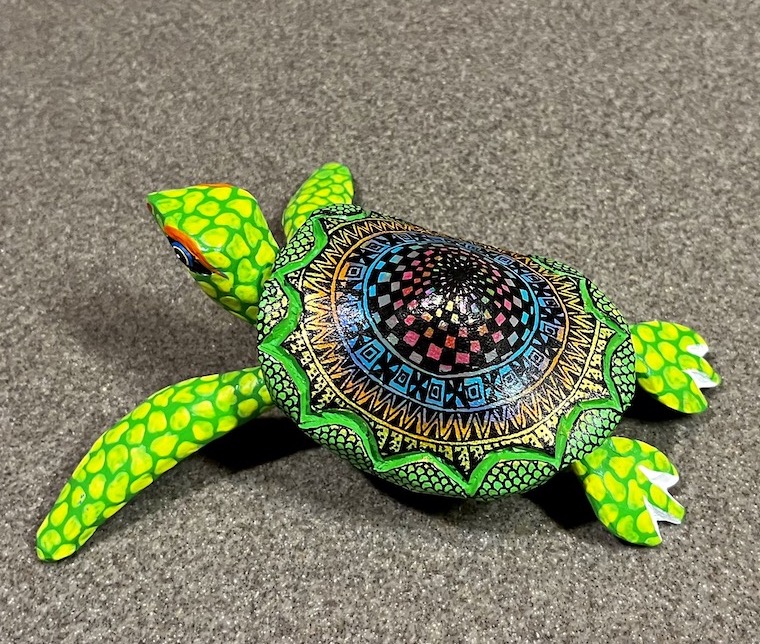
My tortuga – made by a master
My patience pays off, because just two days later, in the sprawling artisans’ bazaar just erected on Alcalá, I meet Hedilberto Olivera, one of the most famous artists from the other village most famous for its alebrijes, San Martin Tilcajete. His work is incredible, smoothly carved, solid and intricately painted.

And…he has a tortuga of the same size as the one I’d passed up in Arrazola. And it’s only $150 usd. Deal!

The bonus is I get to chat with the artist, who seems delighted that this tall, very white old man speaks his language. I always enjoy this kind of personal, heartfelt transaction. (Ironically, after getting to know Hedilberto, I’d gladly have paid him the same 5,000 pesos I’d denied the nameless kid in Arrazola.)

Ceramics
Spirit animals aren’t the only art form to celebrate in Oaxaca. There’s also the pottery. In Santa Maria Atzompa, I visit the workshop of a family that makes elaborate, brown terra cotta pieces—most of them decorative figurines bedecked in hundreds and hundreds of little ceramic flowers.

The woman who welcomes us is, I suspect, a member of the Blanco or Vásquez families, whose antecedents established their signature style and brought world-wide renown to their village. With her two-year-old daughter looking on, she takes a few lumps of clay, which is dark gray when wet, and demonstrates how to make a small figure—a sort of demonic man-beast-spirit amalgam with horns and a tail—and a few small flowers.


Textiles
The next of Oaxaca’s outstanding handcrafted arts that I’m able to glimpse this trip is its sumptuous textiles. Many shops and galleries display gorgeous bags, table runners and, certainly the best known of Oaxacan weavings, the tapetes, or woolen rugs, with their rich colors and distinctive Zapotec motifs. (Sally and I already have a beautiful tapete which we bought from a Oaxacan weaver in Zihuatanejo, Guerrero.)

Some of the shops even feature their own pedal looms, though I don’t get to see the weavers in action.

For a broader sampling of the state’s textiles traditions, I visit the Museo de los Textiles, which exhibits works of weaving and embroidery in scores of distinct styles representative of various parts of the state.

They range from the Mazatec style embroidery—from the northern part of the state bordering on Veracruz—with patterns of animals and flowers rendered on white cotton muslin skirts and blouses; to a slightly more refined gancho style—from the eastern Istmo region; to very fine, tightly-woven, muted-color wool ponchos and serapes—from Teotitlan del Valle. 


Graphic Arts
Tlachiquero: one who
extracts agave "honey"


There are so many nice little galleries and workshops around Oaxaca’s historic center that it’s hard to walk a block without passing one. Alebrijes, pottery, textiles, and lots and lots of graphic art, which this former graphic designer especially appreciates.

I also wander into the elegant Graphic Arts Institute of Oaxaca, where an elegant young woman shows me around the exhibits, including some impressive old lithograph, etching and letterpress presses.

I decide not to spend a lot of time in the crowded print galleries, but I do manage to find a very nice, packable-size print, a composition of various Día de Muertos themes, at the El Pinche Grabador Gallery.

As with the other aspects of Oaxaca’s feast for the senses, I only have time for a few tastings of its art and handicrafts, and I’m leaving still hungry for more. Next time, I'll sample more: painting, basketry, black (barro negro) pottery, jewelry...

* Wikipedia

Sunday, May 28, 2017

MY AMAZON ADVENTURE – Part III: Art and Craft

INTERSECTIONS
I will not pretend to understand Peru from the very limited duration and reach of my recent visit—and even that from quite a privileged point of
view. But that’s the wonderful thing about art; it allows one a legitimate impression, a feeling, about a place that need not hinge on comprehensive knowledge nor on any dialog but that between artist and beholder.


What I did learn about Peru is that, while its people certainly share the same fundamental aspirations as every other human population on earth, they are also colored by a lineage, a geography, a range of climate, and a collective memory that makes each community absolutely unique. And it is the intersections between those shared human qualities and those singular experiences and challenges where culture is forged.


I spent the first two days of my trip in Lima. I loved the vitality, sophistication and sheer range of artistic expression I saw there—from grand-scale works of architecture and monumental sculpture, to revered works in museums, to edgy graffiti and street performance.


WITH THE FLOW
What a contrast, then, when I flew two hours northeast to the smaller, seedier frontier city of Iquitos, the main point of access to the upper Amazon. There, the influence of that fabled river and the all-encompassing rainforest it sustains seems to color everything, not just in the ubiquitous visual themes of water, wildness and wonder, but in the practical nature of tools, weapons and regalia crafted by hundreds of rainforest tribes over the ages and now on display in museums.
 

Also evident in Iquitos, scattered architectural remnants of the era in which both the rainforest’s natural bounty and the labors of its human inhabitants were first successfully exploited by outsiders on a massive, industrial scale—the rubber boom of the late 19th and early 20th centuries.


     These people...seldom enjoy the 
     luxury of creative expression strictly 
     for personal or political ends.

Once I was on the river, the further away from urban life we got, the simpler and more utilitarian the objects of art and craft became. These people, amidst the daily challenges of surviving in this unforgiving place, seldom enjoy the luxury of creative expression strictly for personal or political ends. Most everything has a practical purpose, albeit sometimes with some decorative flair.


At many of the villages we visited, after “show-and-tell” about life in the community was over, artisans would make a modest effort to sell us their wares—generally quite simple but beautiful baskets, wood carvings, various decorative objects and items crafted of gourds or coconut shells.


Perhaps these artistic and cultural expressions will mean less to you, out of context, than they did to me seeing them in the moment and in the flesh. Or perhaps you’ve been to the area and experienced some of them for yourself. At any rate, I hope at least some of them will speak to you, as they have to me, of people, place and purpose.


Wednesday, December 9, 2015

CUBA – Art and Soul

Remember that scene from Jurassic Park where Jeff Goldblum’s character, Dr. Malcolm, questions the bio-engineer’s reassurance that the dinosaurs couldn't possibly breed outside the park because they were all made females? And Dr. Malcolm warns that “life finds a way?”

In Cuba, an island nation isolated in so many ways from the rest of the world, that’s the way it is with art. Despite the stifling effects of a half-century embargo by the US, and a communist government not known for its support of free expression, Cuban art is finding a way.

Some Cubans are managing to rise above their hardscrabble existence and soar the clear-air currents of creativity.

During my first couple of days staying in Old Town Havana, it was hard to see beyond the surface—the work-a-day hustle and bustle of Habaneros, the widespread decay of buildings and infrastructure. I found all those forms, faces, colors and textures, if not uplifting, at least oddly photogenic. At first, that's all I saw.

But then, exploring side streets and poking my head into doors, I started seeing art and even meeting a few of the artists at work. Indeed, at least some Cubans are managing to rise above their hardscrabble existence and soar the clear-air currents of creativity.

MESSAGE OR MEDIUM
What does Cuban art have to say? I cannot begin to judge where creative expression stops and political statement begins, though I suspect nothing even close to the subversive ever finds its way to a public space in Cuba. Nonetheless, even if the works I discovered might fall a bit short of freeing the person, certainly, simply by capturing a place, a time, a feeling, they have the power to free the spirit.

To understand this, it helps to draw a parallel with Cuban music, a medium no one seems to fault when it eschews weighty issues like oppression and injustice. Cuban art—or should I say the art I was able to see in a narrow window of space and time—is, like the music, more about escapism than protest. It's not so much the lyrics that matter. It's the rhythm.

The media range from straw, to paint, to bronze; the canvases, from wet paper to building walls, to towering cliffs; the venues, from back alley, to back-room gallery, to stately hall.

Here are just a few images of that vibrant, irrepressible art.

"The Eye of the Hurricane," "I don't want cheese anymore." What does this say...and to whom?
 
Untitled sculpture by Roberto Fabelo in Havana's Plaza Vieja
Painter Lázaro at work in a back room in Viñales.
The "Prehistoric Mural" near Viñales turned out to be a very contemporary mural with a prehistoric theme.
At Havana's Experimental Graphics Studio, an exhibition of rhinos-only prints.
"La Conversación" by Étienne Pirot. Being in front of the trade center building, this would be translated, I was told, as "The Negotiation."
Private gallery in the back room of my friend Leandro's home.

Mural by Andrés Carrillo in Havana Vieja depicts 67 iconic figures in Cuban history.

In the lobby of the National Museum of Fine Arts
Artist at work in the Experimental Graphics Studio in Havana.
"Blue Flower" – one of four prints I bought at the Experimental Graphics Studio