Friday, July 26, 2013

RELEVANT ELEPHANTS – A Serendipitous End to a Kenyan Safari

(This is the first in a series of posts about my just-completed trip.)

A few days before my wife, Sally, and I took off for Kenya, I walked into Barnes & Noble for a book to take along. I wasn't looking for anything necessarily pertinent to Kenya, nor even to Africa.

Naturally, I headed the Nature section. (The first thing that caught my eye was the three copies of my own book, Under the Wild Ginger – A Simple Guide to the Wisdom of Wonder—which I slid out just couple of inches so the next browser couldn't miss them.)

The story turned out to parallel many of 
the places and species we were seeing. 

All I wanted was a nice adventure story, something involving real people, Nature, survival against the odds (or at least redemption) and, of course, wonder. Scanning the twenty or so shelves of titles, I narrowed it down to three possibilities and then settled on a book about a woman whose parents settled in Africa in the 30s and who grew up and spent the rest of her life in intimate contact with animals.

Barely noticing the title or author's name, I dove right in. To my surprise and delight, the woman's story just happened to be set in Kenya, and, as we made our way around the southeastern quadrant of the country, turned out to parallel many of the places and species we were seeing.

OF PENS AND PENS
Flash forward to the last day of our incredible 13-day safari. We'd returned to Nairobi, where we had the afternoon off before heading to the airport for the first leg of our 21-hour flight home. Maria and John, the very nice young couple from New York City we'd been traveling with asked us to join them on a visit to a center for orphaned baby elephants and rhinos just outside of the city.

The Orphans Project of the David Sheldrick Wildlife Trust was an absolutely enchanting place. Our visit was timed to coincide with the daily round-up from the grounds and retirement to their pens of all 20 or so baby elephants currently in residence. In ones, twos and threes, they all came trotting dutifully around the bend and paraded right past us on their way "home" for the night.


Once they were in their pens we were able to meet them up close, petting them, talking to them and, if we were lucky, getting to shake a soft, yet bristly, little trunk or two.
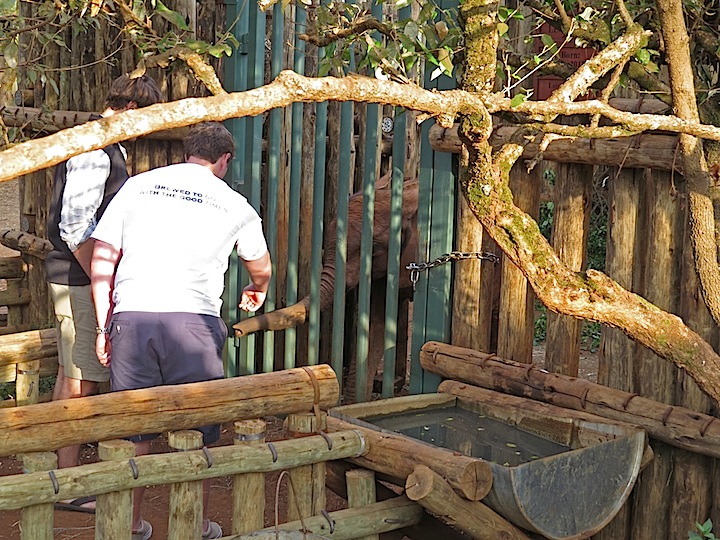

Sally "adopted" Narok, one of the babies named for a town we'd driven through the week before.

Sally "adopted" Narok, one of the babies named for a town we'd driven through the week before. And, while signing the paperwork, she happened to notice a book for sale in the shop, a book written by the Trust's founder, Dr. Dame Daphne Sheldrick—a signed copy, no less. Feeling sure I'd like it, she bought it for me.

When Sally handed the book to me it dawned on her; "Isn't this the same book you're reading?" she said. I looked at the cover, and, though the design was quite different, the title, Love, Life and Elephants – An African Love Story, looked eerily familiar. And guess what. I now have two copies of an amazing, wonderful book, one with which I now feel a powerful personal connection.

MORE TO COME
This little story exemplifies the wonderful, often truly magical, character of our experiences in Kenya. I invite you to stay tuned here, and on my travel blog, El Viajero Contento, for a serial account of the unforgettable people, places and natural wonders we encountered.


Sunday, October 7, 2012

A WALK IN THE WOODS – Wisconsin Wonders

A few shots illustrating this weekend's much-needed respite from two years of quite faithful ten-per-month blog posting and the recent, unaccustomed concerns of book promotion to what truly inspires and restores me — time spent with good old friends, the celebration of Nature's small wonders and the simple joy of being.


Sunday, February 12, 2012

HUBBS CLASS: Hello and Happy Valentine's Day!

Hello, students! How are you all this Tuesday evening? Will you all be my valentines? Are you doing anything special to celebrate this special day of love and friendship?

I'm writing from here in the beautiful town of Zihuatanejo. It's located in the Mexican state of Guerrero, on the country's west coast. We're right on the Pacific Ocean. The villa we rent is about two blocks from the beach, perched high on a hillside overlooking the bay.

Here's the view from where I'm sitting in a photo taken during the day.

The view from our villa overlooking Zihuatanejo Bay.

As I write tonight from my open-sided living room, the sound of the waves crashing on the beach sounds like it's right next to me. Cool breezes flow in, cooling the room and me after another hot, sunny day. Now and then a butterfly or a couple of bats will fly in, right over my head. The bats want to perch in the corner of the kitchen ceiling, but they see me and that it's too bright, so they leave. I worry about the butterflies, because several small lizards (geckos) always run toward them looking very hungry. So far, the butterflies have always escaped.

Tonight, my wife and I went to a friend's house for a drink, and then walked across town to have dinner together. My wife had a huge baked potato with butter and sour cream. Our friend and I had tacos, made with soft flour and corn tortillas wrapped around different kinds of meat and cheese. There are several kinds of sauces to put on the tacos too. Some of them are very spicy hot, so I only use a little bit.

Walking back, we saw people putting up many little tables and stands along the streets where they will sell all sorts of Valentines (Día del Valentín) things, like candy, greeting cards and decorations -- much of it colored red or pink and in the shape of hearts. Has anyone given you a Valentines Day card or gift?

This afternoon we walked across town about two-and-a-half miles to a big grocery store where we stocked up on groceries for the week. Then we walked home, carrying the heavy cloth bags full of food, milk, juices and other things. They were really heavy and we were glad to get home.

In just one more week, my daughter, her husband and my two grandchildren will be flying down here from Boston for a week. We're very excited about their visit, and hope very much that they'll like it here as much as we do.

QUESTIONS?
If you have any questions you'd like to ask me about this place, about how it feels for me trying to speak a second language in a new country, or about anything else, please leave a comment and I'll try to answer in time for your next class.

I have to end this because it's late and I'm pretty tired. I hope you're all having a good class, learning a lot, and LISTENING to your teacher!  ;-)   I'll see you all again in a few weeks.

Your volunteer teacher, Jeff
P.S. Here are a few more photos:

Sailfish on their way to the public fish market.

Me talking with some young students about fishing.

One of the geckos on the wall of our room.

A seed pod and flower of the African tulip tree.

One of the many street musicians in Zihuatanejo.

A man casting his net for bait fish.

A roseate spoonbill

One of many kinds of fish for sale at the fishing pier every morning.

The end of another perfect day!

Wednesday, April 13, 2011

SPREADING THE WORD - Jeff's New Guest Post

As El Viajero Contento and my other blog, One Man's Wonder, slowly but surely gain a larger international following, I've been making some wonderful, often serendipitous, acquaintances with other thoughtful bloggers -- kindred spirits, if you will.

One such friend is View From the Pier, a travel blog that is, to tweak a word, wonder-full. Author, photographer and traveler Meg Pier does a superb job of weaving together colorful strands of adventure, human interest and mystical experience in her articles and interviews. Her work has also been published  in the Huffington Post, the Boston Globe and a number of other media, as well as in several of her own books.

I'm proud to say that View From the Pier has published my guest post, IS IT JUST ME? – My Boquete Epiphany. Many thanks to Meg!

HERE'S THE LINK: IS IT JUST ME? – My Boquete Epiphany

Friday, January 14, 2011

NATURE AFTER HOURS – Frog Serenade at Las Ranas

With overexposure threatening the earth’s remaining wild places, we now have to regulate people’s access to many of them. Parks and nature preserves close for the night. Wilderness areas limit the number of people allowed to enter or the length of time they can stay. In a way, this is sad, but I suppose it’s a good thing, considering how many of Nature’s gifts we’ve already managed to love to death. 

Were they addressing the spirits that dwell here? Or were they the spirits?

Still, I’ve often wondered if Nature isn’t one step ahead of us. Do you think she might, out of sheer spite, decide to wait until these places empty out and close their gates for the day before letting down her guard and revealing her best? 


LUCKY LAGGARTS
My friend, Silverio, and I were exploring the northeast corner of the Mexican heartland state of Querétaro. 

Climbing into the Sierra Gorda, we came to Las Ranas, the archeological site of a pre-Hispanic Totonaca town, featuring nicely excavated and restored pyramids surrounded by elaborate, walled stone terraces stair-stepping up the side of a steep hill. Turns out we’d arrived pretty close to the site’s surprisingly early closing time. The two disheveled guards told us sternly to make it quick, and that we’d better be out by 4:00.
 
We wandered among the immutable gray stone structures. One was an arena of sorts, site of the ancient pelota game (which looked, in artists’ representations, like a precursor to soccer). Silverio told me this game, though not played any more, remains an important symbol to many Mexicans. I’d heard elsewhere that the Aztecs took it so seriously that losers were routinely sacrificed to the gods!

...the wave had crested right over us, filling the treetops, inundating us in a raucous chorus of dry, raspy twittering.

By the time we'd worked our way up to the highest spot on the site, I noticed that the few other visitors had all left; it was already after four. The prospect occurred to me of being locked overnight inside what might be a pretty eerie place in the dark. Should we rush out? Then we remembered we’d actually parked outside the gate and could easily scale the flimsy fence. We looked at each other, at the timeless structures surrounding us, and then at the gorgeous view across the lush gorge. What the hell, we decided, they'll just have to come get us. (In fact, we didn’t see them again.)

Now that we had the place to ourselves, everything felt different. It was that rare sense of privilege you experience when you have something really good all to yourself. We sat in silence for several minutes, soaking in the stillness, communing in our own ways with whatever spirits might still dwell there.

Illustration: Katy Farina

A TWITTERING TSUNAMI
Suddenly an incredible drama started to play out. In the distance, from the bottom of the gorge, we heard a faint, eerie murmuring sound, like people whispering—lots of people. Then, like a tsunami, the sound swept up the hillside toward us, swelling in its intensity. Within about ten seconds, the wave had crested right over us, filling the treetops, inundating us in a raucous chorus of dry, raspy twittering. Then the wave ebbed, sweeping back down the hillside and fading back to stillness. It all took less than a minute.

Our awe gave way to more curiosity. Could this be how the place got its name? Did the frogs always act like this, waiting every day until they thought they were alone before speaking out so unanimously? Were they addressing the spirits that dwell here? Or were they the spirits?
 
This post is part of my "Mexico – Ten Best" Series / SERIES CONTENTS 

Sunday, December 12, 2010

SNOW FOR THE SNOWLESS – Sharing the Wonder

For my friends in Mexico, Panama, Costa Rica and other parts of the world not blessed with the wonder of snow, here are a few images of our beautiful, white landscape after our first big winter snow storm.
Para mis amigos mexicanos, panameños, costarricenses y ustedes de otras partes del mundo en que no cuentan usteds con el asombro de la nieve, aquí tenemos unas imágenes de nuestro hermoso paisaje de blanco después de nuestra primera tempestad invernal.

When we northerners visit your countries' landscapes, warm year-round with greens, browns and all the floral colors, with those plants and animals we've never seen before, it seems so fascinating, so exotic. For you, though, it's what you see every day; you might take it for granted. But if you could come here on a winter day like this, I know you'd be struck by that same kind of enchantment.
Cuando nosotros norteños visitan los paisajes de sus países calentados por colores de verde, de marrón y de flor, con todas las plantas y animales que nunca hemos visto, nos parece muy fascinantes, muy exóticos. Sin embargo, para ustedes, eso es lo que ven cada día; tal vez se lo den por sentado. Pero, si ustedes pueden venir acá durante un día invernal como este, es cierto que se quede encantados.

Our sidewalks have walls.

Some people's cars get snowed or plowed in.

These bikes won't roll today.

Sure beats shoveling!

Friends and neighbors pitch in.

Tree limbs are etched in black and white.

The frozen Mississippi River, just a block from home.

SOME OBSERVATIONS ABOUT SNOW:

The equivalent of one inch (2.5 centimeters) of liquid precipitation—not uncommon for a summer storm—can result in as much as 20 inches (50 cm) of snow. That's how much we got from the winter storm that passed through here yesterday. For the whole winter here in east central Minnesota, we usually get about 48 inches (1.2 m), but it rarely gets that deep because some of it melts now and then.

When it settles on the ground, snow can be wet or dry, as light as feathers or as heavy as sand. Generally, the flakes are those exquisite, iconic, hexagonal ice crystals, but they can also take shape as plates, shards (needles) or little round pellets we call corn snow. It all depends on the air temperature, how and where the crystals form and several other conditions.

When it's the light, dry kind, snow is fairly easy to walk or drive through; you can shuffle through it like piles of dry autumn leaves, except the sound is softer, like the slightest whisper. But when the snow's heavy and wet, it's harder to navigate, and it can get pretty messy.

Often, after a big snow storm, a mass of brutally cold arctic air will sweep down from the northwest as it has today. This air is very dry, and changes the consistency of the snow so it crunches and squeaks like Styrofoam when you walk on it.

After a few cars or trucks have driven over snow, it compacts into ice. It can be extremely slippery. Those of us who have lived here all our lives have learned how to drive in snow fairly safely. Young drivers, people who are impatient and recent immigrants from snowless climes have a much harder time getting around.

After yesterday's big storm, the city's big snow plows came through the streets, moving the snow to piles along the sides. For the first day, people can't park their cars along the street. If the do, they either get towed away or nearly buried by the plows.

The plowing angers people who have just shoveled out their sidewalks and driveways, since the new piles cover up the areas they've just shoveled. Plows mix up the snow, squeezing much of the air out of it and making it dense and very heavy.

A big winter storm changes the way people here think about life (not unlike, I suppose, when you experience a flood or a hurricane in your country). The whole community comes outside to see what's happened, and they all pitch in and help each other. It's a nice feeling, one I wish we could share all the time.

But snow's more than just a challenge for us; it's also a delight. One of our favorite Christmas songs is called I'm Dreaming of a White Christmas. And this is just what we do. We hope for snow, so we can enjoy its beauty, so we can play in it, and so the runners of Santa Claus's sleigh will have something slippery to slide on when it lands on each child's rooftop.

We learn, when we're children, to associate snow with play. We roll around in it and throw it; we make "snow angels" by lying in the snow and then sweeping our arms and legs; we dig tunnels into the huge piles left by shoveling and plowing; we build forts and igloos; we sculpt it into statues, we slide and ski on it.

If it's the right consistency, you can pick up a handful of snow and shape it into a ball. We love having "snowball fights," throwing them at each other. Usually they break apart when they hit you, and sometimes the pieces go down your neck inside your jacket. That's almost a funny as it is cold!

If you've never experienced snow, you can't imagine how beautiful it is. It's amazing seeing everything covered in white. Lawns, streets, sidewalks, parking lots, the roofs of buildings—all pure white. Even the trees wear cloaks of white. Those that have shed their leaves for winter have the tops of each dark brown or gray branch crisply etched in white.

The evergreens hold more snow, though often their branches droop under its weight. And—even more stunning than the whiteness,—when the snow is fresh, the sun catches the reflective surfaces of each tiny water crystal, making all of it sparkle like a blanket of diamonds.

I wish you all could see this. Would you like to experience a northern winter? I sincerely hope you get the chance to do so one day!

Friday, December 3, 2010

BOQUETE PANAMA - Parting Images

Most Boqueteños seem prosperous; I love this home, a block from school.

Others live in little more than lean-tos.
False façade against misty mountains

A spectacular fungus – Chorcha, Chiriquí

Butterfly – Chorcha, Chiriquí (anyone recognize the variety?)

Rescued howler monkey, Alouatta Lodge

Habla Ya school director, Lorena, chats with staffer, Ismenia.

An excursion to David; playing Password in Spanish

Woman dressed in traditional pollera – David

My new friend and fellow student, Lucy, from England

My wonderful host, Guillermo, bids me buen viaje.