Showing posts with label Nature. Show all posts

Friday, June 2, 2017

MY AMAZON ADVENTURE – Part IV: Nature

The first three posts here on my recent trip to Peru and the upper reaches of the Amazon have been about the wonderful people I met and observed there; the palpable, all-encompassing sense of place exuded by the great river and the surrounding rainforest; and the vibrant art and craft that gives voice to both.

Truth be told, I wasn’t drawn to this experience by either the people or the culture. And, while the sense of place—all those references in literature and film to the mysterious, perilous Amazon—certainly drew me in, what I really wanted to see was the wildlife.

The Amazon Rainforest is home to one in ten of all living species on earth—at last count 427 mammals, 1,294 birds, 428 amphibians, 378 reptiles, 2,200 fishes, 80,000 plants, and an astounding 2.5 million species of insects.* And those are only the ones researchers have found.

   As we ply a jungle path in search of 
   critters, it’s like slogging through a 
   steam bath after a power outage.

PECKING ORDER
Before boasting of the puny sampling of those organisms I was privileged to see and photograph, a little context:

In this, the largest rainforest biosphere on earth, some incredibly powerful forces and their more-or-less predictable cycles animate all life. The river, consistently rising and falling some 30 to 40 feet each year, is like the region’s pulsing artery; the rainforest, its lungs.


A rainforest this size creates its own weather on a massive scale. The steamy exhalations of billions of plants, cooked out by the powerful equatorial sun, rise each day into the atmosphere. There they’re swirled and cooled, wringing out the moisture as rain. And so it goes, day in and day out.

The plant canopy here is more than just a matter of survival of the tallest. It’s a complex, multi-tiered system. Through both competition and cooperation, each layer is claimed by those plant and animal species which have evolved to do best there.

PHOTO: Kevin Cure via WikiMedia Commons


Sunlight, plentiful for the big boys, is all but consumed by the time it reaches the ground. One perfectly sunny afternoon, as we ply a jungle path in search of critters, it’s like slogging through a steam bath after a power outage—I can’t take a decent picture without flash.

      Our guides uncannily mimic the 
      creatures’ voices, hoping to draw 
      them closer.

SKIFFIN’ IT
The river boat La Perla—our comfortable home for the week—tows two large, outboard-powered skiffs. Every day we cast off in them for excursions into the numerous tributaries and backwaters of the upper Amazon and the Marañon. They also take us to trail heads where we embark on hikes through the jungle. There, facilitated by incredibly skillful naturalist guides—two of them our own; others, local to the areas we visit—we’re introduced to a wide variety of living wonders.

Rothschilds moth

From the skiffs, our guides employ an impressive range of tools of their trade. Their incredibly sharp eyes scan the woods, air and water for telling movements or patterns. Then a quick glance through binoculars confirms or denies a hunch.

If a bird or perhaps a monkey is too far away for the rest of us to see, they uncannily mimic the creatures’ voices, hoping to draw them closer. At times, they even broadcast recorded calls through a microphone.


At the outset of our trip, we’d been given a list of several hundred species of birds we might spot during these excursions. With our guides’ help—in some cases actually borrowing a guest’s camera to take the shot she or he couldn’t manage to frame—we manage to see well over half of them, an impressive list for any birder.

Great kiskadee
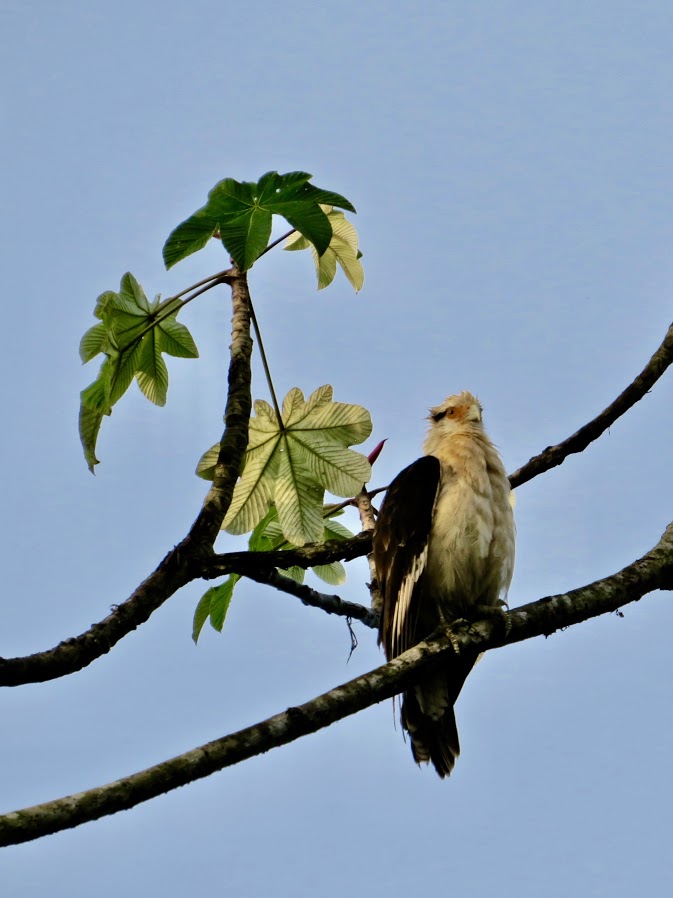
Yellow-headed caracara
Hoatzin

From the water we observe several types of monkey, sloths, caiman…and the revered Amazon river dolphin, or boto. We even fish for the oft-maligned red-bellied piranha.


Pygmy marmoset
Three-toed sloth

Amazon river dolphin - PHOTO: Allen Sheffield via WikiMedia Commons
Red-bellied piranha


We find breathtaking flowers and inch our way through giant, 6-foot-diameter lily pads which, with their turned-up edges and sturdy fretwork substructure, have been famously photographed supporting a small child.

Frangipani
Coconut palm stem cluster
Kapok bud and flower

    After calmly posing it for photos and 
    casually brushing it off, he looks it up 
    in his spider book and discovers it is 
    highly venomous.

ALL CREATURES GREAT AND SMALL
On our ground explorations, while we stick to the path with one guide, the other is constantly tromping off-trail through the jungle, searching for critters large and small. One minute, he presents us with a gorgeous, inch-long poison-dart frog. Ten minutes later, he’s pointing out an eight- or ten-foot palm-like tree he says “walks” across the jungle floor looking for one of the few precious pools of sunshine seeping through the canopy.

Poison dart frog
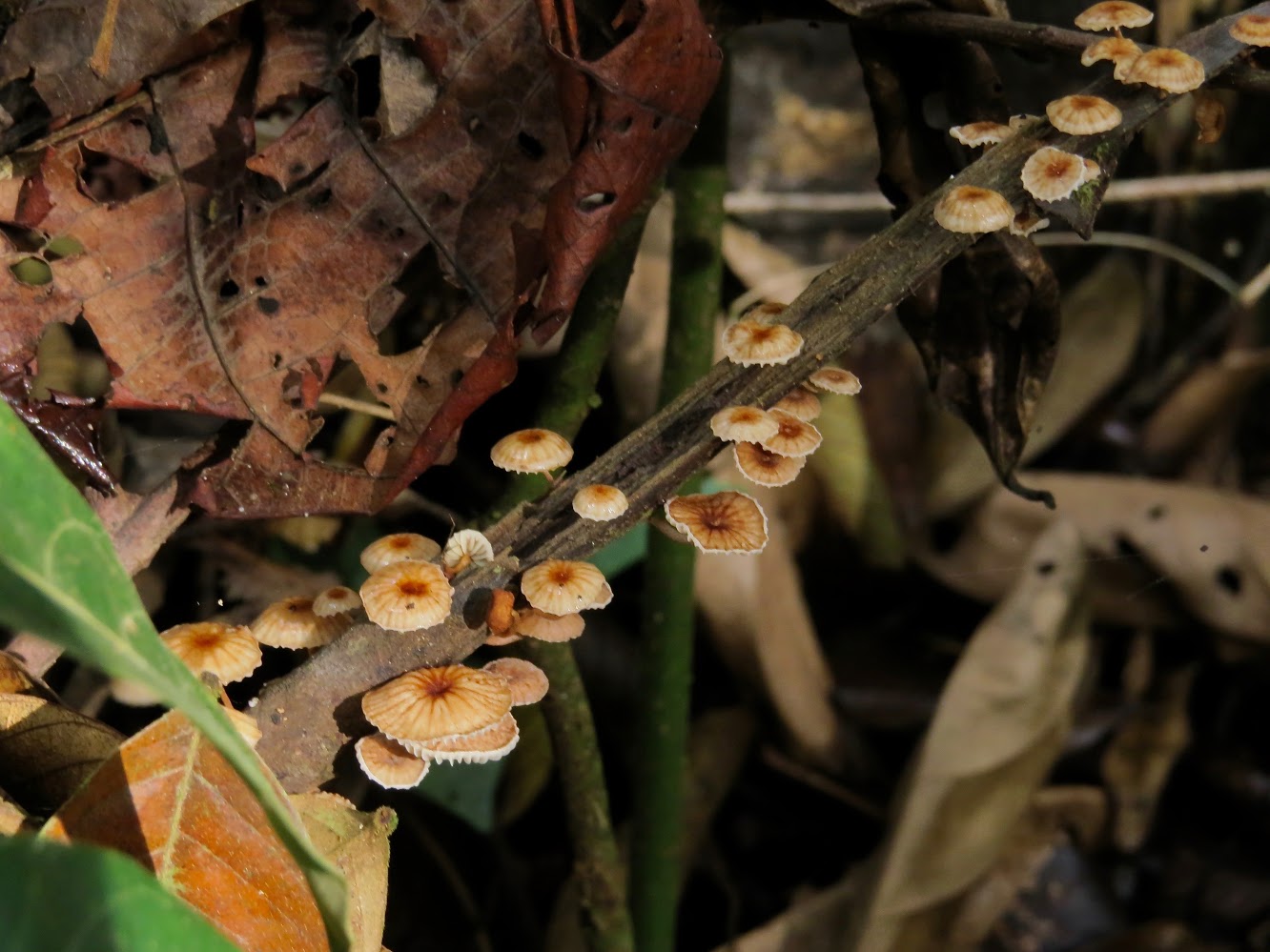
Kapok (lupana) tree with unidentified blue insect


Later, he emerges from the dark, dense foliage once again, this time obviously lugging something much bigger. It takes us a few seconds to make it out in the dim light; draped over his shoulders is a 12-foot boa constrictor as thick as my calf. On another occasion, a huge spider suddenly appears on a guide’s shirt. Later, after calmly posing it for photos and casually brushing it off, he looks it up in his spider book and tells us it is highly venomous.

Red-tailed boa constrictor
Venomous? Looks like a huntsman spider to me – if so, not so much.

One could come here to Amazonia a dozen times and still not see more than a small fraction of its natural wonders—I imagine even natives discover something new every day. I'm privileged to have been able to come here once in my lifetime, if for no other reason than to catch this glimpse of earth's "lungs" first-hand.

The experience only strengthens my resolve to resist, in whatever ways I can, the short-sighted, self-serving, reckless actions of the current U.S. government—especially its willfully-ignorant dismissal of the consensus among climate scientists that our current treatment of the environment is likely to prove catastrophic.

And the reality-star president? Don't get me going; he wouldn't know a tarantula if it bit him on the ass. And I wish one would.


* Wikipedia (https://en.wikipedia.org/wiki/Amazon_rainforest

Monday, May 22, 2017

MY AMAZON ADVENTURE – Part II: Place


THE RIVER
When folks ask me for some of the high points of my recent week-long cruise on the Peruvian Amazon, one of the first things that comes to mind is just the wondrous mystique of that whole vast rainforest expanse. It’s not just the pink dolphins, poison-dart frogs and 15-foot anacondas, or the inscrutable oneness with Nature of its indigenous peoples; it’s also the sheer size and power of the river itself.

(Many of the world’s great rivers count their sources as the confluence of tributaries bearing different names. Our cruise, starting on the Amazon proper, reached upstream into one of its two main feeder rivers, the Marañon.)


Where we were, south and west of Iquitos, the Marañon looked to be fifteen, maybe twenty times as wide as the great Mississippi is back home in Minneapolis. One evening, as we returned to the boat in skiffs after some backwater wildlife spotting, our guide gave us a little perspective on the its contribution to the Amazon’s size.

Pointing to the muddy, flotsam-strewn water swirling around us, he said, “Oh, by the way, right here it’s 250 feet deep.” That, even there at the Amazon’s upper reaches, is 50 feet deeper than the deepest point, near New Orleans, in the entire Mississippi river.


   The Amazon’s total flow volume is 
  greater than that of the next six largest 
  rivers combined.

As I pondered this, the immensity of this river started adding up. The Amazon is fed by some 1,100 other tributaries before it empties into the Atlantic, many bigger than the Marañon—only number 14 among them by length.

This abundance of tributaries and the fact that the area of Amazon’s watershed is twice that of the Mississippi—which itself drains more than 40 percent of the continental US—begins to explain why the Amazon’s total flow volume is greater than that of the world’s next six largest rivers combined.

The Amazon's estuary and silt plume from space. PHOTO: Norman Kuring/NASA
That volume reaches up to 300,000 cubic meters per second (11,000,000 cubic feet per second) in the rainy season, with an annual average of 209,000 cubic meters per second (7,400,000 cubic feet per second). At that rate, the Amazon is responsible for no less than 20% of the fresh water entering the Earth's oceans.

The river pushes a vast plume of fresh water out into the Atlantic Ocean, reaching some 400 kilometers (250 miles) long and between 100 and 200 kilometers (62 and 124 miles) wide.
 
     This place is home to one fifth of 
     all the bird species on Earth, and 
     one third of all plant species.

WRINGING THE SPONGE
As captivating as the Amazon’s sheer immensity may be, there’s more to a sense of place than scale. First off, the Amazon Rainforest is…well…a rainforest. (Okay, it’s hard to avoid the scale thing; at 1.7 billion acres, it’s nearly twice the size of the next largest tropical rainforest, and is appropriately nicknamed the “lungs of the earth.”)

A rainforest this size creates its own weather on a massive scale. The steamy exhalations of billions of plants, cooked out by the powerful equatorial sun, rise each day into the atmosphere. There they’re swirled and cooled, wringing out the moisture as rain. And so it goes, day in and day out.


This daily cycle is mirrored in the region's semiannual rainy/dry cycle of seasons. All life here has adapted to the river's predictable 30-foot annual rise and fall, and the flooding of some 140,000 square miles of forest. Tree trunks and the jungle floor, home for half the year to creatures that walk, crawl and slither, become the realm of fish and marine mammals the rest of the year.

PHOTO: Kevin Cure via Wikimedia Commons

The heat and humidity support an astounding range of plant and animal life. Like a colossal, multi-stage Darwinist coffee maker, the jungle canopy comprises at least four distinct levels, the occupants of each extracting what they need from the light, water and air movement percolating through it.

To one unaccustomed to the combination of heat, humidity and light-devouring density of foliage, the jungle here, even at mid-day, feels like a steam bath during a power outage. (I couldn’t take a decent photo without flash.) One can only admire the species, including homo sapiens, which have managed to adapt so successfully to such a climate.

THE SCOURGE OF HUMAN ENDEAVOR
In an environment this unique, this exotic, the notion of place eclipses that of time. How immediate it seems, the fact that this place was once attached to Africa.

Geologically, the pieces—today’s continents—fit like those of a jigsaw puzzle, and, though I know the supposition has been debated by science, many of Amazonia’s species—from certain types of rodents, to monkeys, to large cats, to aquatic mammals and fish—would appear tellingly similar to antecedents found only in Africa.


Paralleling the geology is the amazing hydrological history of the Amazon. At one time, the river actually flowed from east to west. But with the splitting of the South American and African continents some 120 million years ago, and the subsequent upheaval of the Andes, the flow was blocked, creating first a vast inland sea. Then, fed by snow melt from the new mountain range, the sea eventually burst through to the Atlantic, and the Amazon resumed its flow, this time west to east.

In more recent history, Amazonia has been ruthlessly exploited for monetary gain, from the collecting, processing and transporting rubber, to the messy mining of gold, nitrates and guano, to harvesting the rainforest’s rare woods and medicinal plants, to the clearing of more than eight square miles per day for cattle grazing, coca production and other commercial development.

Iquitos's Iron House - Gustave Eiffel, 1889
The effects of the rubber boom—from roughly 1880 to 1915, and again briefly during World War II—can still be seen in Iquitos, Manaus and Belém, where vestiges of European wealth and sensibility still adorn the architecture. The era's ruinous effects on the population and cultures of the region’s indigenous peoples will do doubt outlast the most durable of those buildings.

Today, the brutality inflicted on this land, on these people, remains raw as the world continues demanding more and more of Amazonia’s natural riches. And it is impossible to marvel at the place’s natural beauty without acknowledging—without feeling—that reality.

YOUR PLACE OR MINE?
Of the many unforgettable experiences of this trip, one stands out for its eloquence in articulating this ineffable sense of place.

So, one evening just as the sun is setting, we’re on our way back to the cruise boat in the skiffs. We’re in the middle of a rather wide part of the river, near where the Marañon and Ucayali join to form the Amazon proper. There’s a spectacular sunset. No, wait, there are two…no three.

PHOTO: FrankMoreno.com.mx

Looking around the 360-degree panorama, I see three distinct areas of bright horizon and Turner-worthy peach-pink clouds. And, swear to God, I can’t tell which of them is the one, real sunset. Never have I seen anything like it, and our guide, perhaps inured to the phenomenon, casually points out the genuine article, but cannot explain the imposters.

We head over to within 50 yards of the eastern bank, where a spectacular stand of 12- to 15-foot pampas grass sways in the barely perceptible breeze. Our guide suggests we be quiet, listen and wait. Within a few minutes, a flock of a dozen or so green parrots, jabbering excitedly—flying all the way across the river and right over our heads—alights atop the elegant plumes of the pampas grass.


Then, from a slightly different direction, comes another flight. And then another…and another…and another. For the next fifteen minutes, from all over the surrounding rainforest, for miles around, they come by the scores, the hundreds, to roost for the night. By the time we leave, we have to shout to one another to be heard over the din.

PRIVILEGE AND POWER
The parrots have found their place here in this tall-grass microcosm of Earth’s greatest rainforest. A few billion other critters, having evolved over eons to thrive here, have found their places too. And so, one would hope, have I.

This precious week has shown me both how insignificant and how powerful I am: insignificant for the rarified millisecond in evolutionary time that I've spent here, hoping to better understand one or two things about this incredibly vast and complex biosphere.

Powerful in the fact that my species, in the way we live, the personal and political choices we make thousands of miles from here, may well hold the key to continuing survival for this timeless place and all its inhabitants.

I am deeply grateful for the chance to better realize the connection...and the difference.

Friday, December 4, 2015

CUBA – Orchids of Soroa

It’s November 11, and I’m heading a couple of hours southwest of Havana to Artemisa Province and the tiny spa/resort village of Soroa. It will be a relief to claw my way out of the gritty, claustrophobic street-canyons of Old Town Havana for some peace and fresh air.

I hook up with my Spanish school compañeros, Meg, Suzanne and Charles, in the tiny plaza in front of La Floridita—reputedly Hemingway’s bar of choice whenever he craved a daiquiri´. There we meet our driver for the day, Lazaro, along with his pride and joy, his nicely restored 1956 Chevy Bel Air.


(Lazaro finished medical school, but hasn’t yet found a job. What’s more, at a doctor’s salary of 1,060 Cuban national pesos—about $40 usd—a month, he didn’t seem to mind driving tourists around for $75 a day!)

Turning north off the Autopista Este-Oeste (Route 4), we wind our way up a long, narrow valley to El Salto Park, where we pick up the climbing trail up to El Mirador (Overlook) de Soroa. It’s a hot, sweaty climb, but the rewards along the way—flora, fauna and even the rocks’ and trees’ amazing forms, colors and patterns—are well worth the effort.


After the beautiful half-hour trek we’re looking out over a broad sweep of the lush hills and plains of Pinar del Rio—and down on the backs of soaring vultures.


Once we’re back down, Meg and Suzanne decide to pay the three-peso (CUC) admission to cool off under the wispy, 20-meter salto (waterfall) while I play with some of the amazing touch-me-not plants (Mimosa Pudica) that furl up when brushed with a finger.

Some orchids are so playful, so animated
as to conjure characters from a fairy tale.

LABOR OF LOVE
From El Salto we head down the road to the Orquideario Soroa, the largest botanical gardens in Cuba—and, some claim, the second biggest orchid gardens in the world. Built by Spanish lawyer Tomás Felipe Camacho in 1943 in memory of his wife and daughter, the lovely eight-acre grounds feature some 700 orchid species, including many endemic plants. Though Camacho died in 1960, the Orquideario, now supported by the University of Pinar del Río, continues to thrive.

(Admission to the Orquideario costs three pesos (CUC) for a person—plus an additional peso for a camera!)


Our knowledgable guide explains the origins, preferences and significance of each specimen—though I must say I’m distracted by the sheer visual impact of such gorgeous flowers, some so playful and animated in form as to conjure characters from a fairy tale.


Unfortunately, not all orchids bloom at the same time. Alas, Cuba’s splendid national flower, the mariposa (butterfly) orchid, (Hedychium Coronarium), with its intoxicating, gardenia-like fragrance, is among the absentees. But the other amazing orchids of Soroa fill in nicely and will forever decorate the sultry alcoves of my happy place.


Tuesday, December 1, 2015

POOR, RICH AND RIGHTEOUS – Top 25 Images of Cuba

Cuba is like that weird uncle no one ever sees any more. Once the life of the party—an anything-goes spree destination for well-heeled American socialites, celebrities and the mob—the exotic country just 90 miles south of Key West suddenly became persona non grata.

So close, yet so far away.

While visiting Cuba the first two weeks of November, I was struck by the obvious effects, not just of the half-century US embargo, but of the influences of other countries—especially Russia and China—stepping in as allies. Given such connections, one wonders how the communist government, though providing certain first-world benefits like free health care and education, has managed to deprive so many of its citizens, for so long, of any broader sense of prosperity.

No sooner do the airs of one lively salsa or rhumba band fade than those of another two blocks ahead rise to the ear.

But Cubans count assets other than a high standard of living as it is understood elsewhere in the world. The flavors of their diverse heritage—European, African and Indigenous—blend in a savory stew of cultural energy. A distinct pride of survivorship keeps the great Revolution on low simmer, still evident in folks' erect bearing and in defiant propaganda splashed on walls and billboards. And Cubans are nothing if not resourceful, scrimping, saving and improvising to make do with their limited resources.

ISLAND RHYTHMS
The country's lush, tropical landscapes, from jungle to beach to highland coffee plantation, are breathtakingly beautiful. There's a surprisingly strong sense, even when one is beyond sight of the ocean, of this being an island—something, I suppose, about how the air feels and smells, and how close even a distant thunderstorm seems to loom.

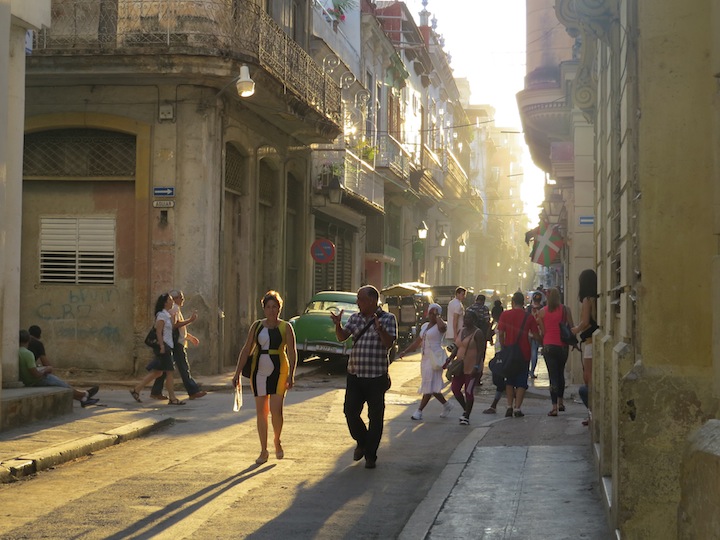
Even gritty La Habana Vieja, old-town Havana, though at first glance a ruin, holds its own charms. Through the structural decay shine glimpses of grander days. Some landlords have managed a bit of restoration, even if it's only a fresh coat of paint. Here and there, vibrant art delights and challenges the eye, and music is everywhere—no sooner do the airs of one lively salsa or rhumba band fade than those of another two blocks ahead rise to the ear.

While a people can hardly be characterized by a tourist's limited impressions, I found the Cubans I met on the streets and in the countryside to be friendly, welcoming, curious…and surprisingly optimistic. Most are excited about the thaw in relations with the US, looking forward to new opportunities and reunions with long-separated family members living there.

EYE OF THE BEHOLDER
I can't share all the warm smiles, the welcoming handshakes, the tastes and smells, the music's beat. Those you will have to experience for yourself.* But I can offer a few of the images I captured with my camera. Of the 1,000-plus I snapped, here are my best 25.
* Keep an eye here and on my other blog, One Man's Wonder, for my upcoming post on how you can spend a couple of amazing weeks in Cuba—legally—for less than $1,500, about a third the price charged by most tour companies.