Cuba is like that weird uncle no one ever sees any more. Once the
life of the party—an anything-goes spree destination for well-heeled
American socialites, celebrities and the mob—the exotic country just 90
miles south of Key West suddenly became persona non grata.
So close, yet so far away.
While
visiting Cuba the first two weeks of November, I was struck by the
obvious effects, not just of the half-century US embargo, but of the
influences of other countries—especially Russia and China—stepping in as
allies. Given such connections, one wonders how the communist
government, though providing certain first-world benefits like free
health care and education, has managed to deprive so many of its
citizens, for so long, of any broader sense of prosperity.
No sooner do the airs of one lively salsa or rhumba band fade than those of another two blocks ahead rise to the ear.
But
Cubans count assets other than a high standard of living as it is
understood elsewhere in the world. The flavors of their diverse
heritage—European, African and Indigenous—blend in a savory stew of
cultural energy. A distinct pride of survivorship keeps the great
Revolution on low simmer, still evident in folks' erect bearing and in
defiant propaganda splashed on walls and billboards. And Cubans are
nothing if not resourceful, scrimping, saving and improvising to make do
with their limited resources.
ISLAND RHYTHMS
The
country's lush, tropical landscapes, from jungle to beach to highland
coffee plantation, are breathtakingly beautiful. There's a surprisingly
strong sense, even when one is beyond sight of the ocean, of this being
an island—something, I suppose, about how the air feels and smells, and
how close even a distant thunderstorm seems to loom.
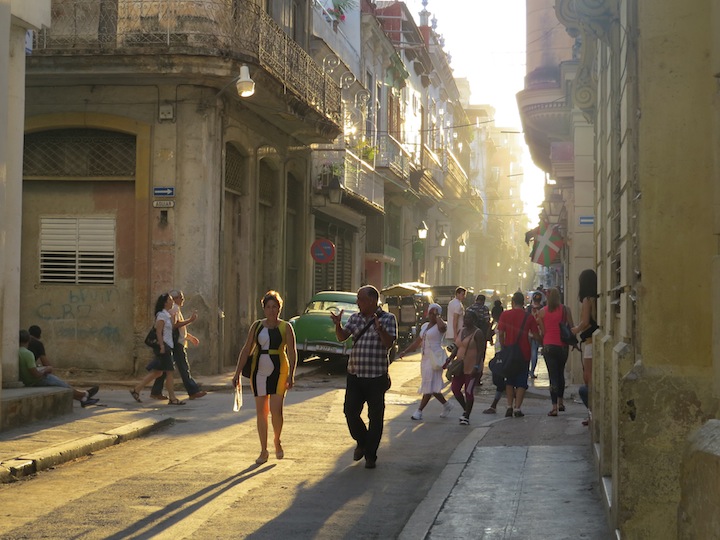
Even gritty La Habana Vieja,
old-town Havana, though at first glance a ruin, holds its own charms.
Through the structural decay shine glimpses of grander days. Some
landlords have managed a bit of restoration, even if it's only a fresh
coat of paint. Here and there, vibrant art delights and challenges the
eye, and music is everywhere—no sooner do the airs of one lively salsa
or rhumba band fade than those of another two blocks ahead rise to the
ear.
While a people can hardly be characterized by a
tourist's limited impressions, I found the Cubans I met on the streets
and in the countryside to be friendly, welcoming, curious…and
surprisingly optimistic. Most are excited about the thaw in relations
with the US, looking forward to new opportunities and reunions with
long-separated family members living there.
EYE OF THE BEHOLDER
I
can't share all the warm smiles, the welcoming handshakes, the tastes
and smells, the music's beat. Those you will have to experience for
yourself.* But I can offer a few of the images I captured with my
camera. Of the 1,000-plus I snapped, here are my best 25.
* Keep an eye here and on my other blog, One Man's Wonder, for my upcoming post on how you can spend a couple of amazing weeks in
Cuba—legally—for less than $1,500, about a third the price charged by
most tour companies.
Showing posts with label open-mindedness. Show all posts
Tuesday, December 1, 2015
Monday, October 5, 2015
IS IT JUST ME? – My Boquete Epiphany
I was in the sweet little mountain town of Boquete, Panama for two
weeks, part of my quest to experience more of life and chase my elusive
dream of Spanish fluency, whatever that is. Trips like that are always
eye-openers for me. I get to see how the vast majority of earthlings
live, and how the roiling confluence of that lifestyle with
the relentless current of the new "world culture," so long on aspiration
but so short on patience, affects their simpler, purer—some would
say more sustainable—traditions.
But that trip proved to be more than merely instructional. One day I had an epiphany. Here's my account, written that very day:
–/-/– –/-/– –/-/–
Habla Ya, the fine Spanish school I'm attending, arranged for me to stay with a local family. Señor Guillermo Bell Miranda is a coffee farmer, working the land atop the steep cerro just behind his home. He and his extended family couldn't be nicer or more generous with their home, their time and their help with my Spanish. Nonetheless, I had just two requirements for my lodging: a bed at least six feet long, and WiFi (so I can keep up with my commitment to regular posting here and on my travel blog, El Viajero Contento. (http://elviajerocontento.blogspot.com) With classes taking up most of the day, and the prospect of a few excursions into the gorgeous area surrounding Boquete in the mornings, I was counting on being able to connect with the Internet every evening, in the privacy of my room.
I saw a crystal clear image of Guillermo's and his family's faces when they learned that I'd found their home unacceptable.
The bed is long enough. But the Internet connection, a sluggish, intermittent, dial-up service, requires 17-year-old Antonio's shoving a well-used CD onto my laptop and installing a huge program.
My reaction to all of this—well within reason, I thought—was to let Lorena, la directora of the school, know that we'd have to find some other arrangement that would accommodate my needs. After all, who's the customer here? Wouldn't anyone in his right mind hold a supplier more or less to the terms of a contract? I assured Lorena that the last thing in the world I want to do is to offend the Bell Miranda family, but work is work.
Just then, another staff member in the office, overhearing our conversation, came over to explain, in what I took as a paternalistic tone, that I couldn't blame the Bell Mirandas nor any average Panamanian family for not knowing all the ins and outs of Internet connections.
My Spanish always collapses to the level of rank beginner when shaken by any degree of emotion. Explaining that to the young man, I let him know, in English and in no uncertain terms, that I wasn't blaming the family at all. And I didn't need to be told that the school's inability to meet my very few requirements was my fault. At this, Lorena jumped in to suggest that they might, indeed, be able to locate another family with WiFi. I reiterated my concern with hurting the feelings of Guillermo and his family with my decision, but she assured me they could explain the situation to the family with minimal offense. So I agreed to that solution and thanked her.
I wondered why I cling so to the
illusion that I can control my life.
I retired to the student lounge (where WiFi is available), and started writing about my first couple of days here. I couldn't think straight. Too many feelings plucking at the edges of my concentration. I tried to imagine two weeks at my adoptive family's home with nothing "productive" to do in the evening, especially considering that they all retire by 9:00 or 9:30.
I recalled, from all my experiences in Mexico, how enigmatic Latin American values can seem to a Norteamericano, but how, at some level I've only occasionally been able to embrace, they made sense. Then I saw a crystal clear image of Guillermo's and his family's faces when they learned that I'd found their home unacceptable.
That's what did it. In that split second of clarity, everything resorted itself in my mind. I released my hold on my frustration, disappointment and self-righteousness, and let acceptance and flexibility gently nudge them aside. And, after all that consternation, the answer seemed so beautifully simple. I wondered why I cling so to the illusion that I can control my life.
So now I'll spend my evenings patiently and happily with this kind, generous family. I'll write what I can without access to information and photos. I'll read my book—very slowly, so it'll last the two weeks. Then I'll use my free mornings to get online at school. Self: see how easy that is?
The cosmos wasted no time in rewarding me for my little awakening. For the rest of the morning, as it turns out, in the busy student lounge, I had the chance to meet many of the staff and my fellow students I'd never have met otherwise. And tonight, arriving home after classes, everything seemed different with Guillermo and the family. Was it just me, or can they see the change in my attitude?
Funny, you can read about how to behave gracefully in other cultures. You can learn some of the language and customs. You can try doing in Rome as the Romans do. I know these things, and have wrestled with culture shock before. But, at least for me, it's taken that little extra jolt, that little injection of emotion followed by reflection, for me to actually get it. Now if I can only remember it.
Labels:
acceptance,
awareness,
control,
culture,
epiphany,
humility,
Latin America,
letting go,
open-mindedness,
Panama,
reflection,
Spanish,
travel
Subscribe to:
Posts (Atom)